As the global wearable device market continues its rapid expansion, smartwatches have evolved far beyond simple timekeeping devices. Modern smartwatches now integrate health monitoring, wireless communication, AI-driven data analysis, and intelligent user interaction, making regulatory compliance more complex and more critical than ever.
For smartwatch manufacturers, brand owners, and importers targeting international markets, certifications are no longer optional checkpoints—they are fundamental to market access, brand credibility, and long-term scalability. This guide provides a structured, practical breakdown of the four most important certification systems for smartwatches—CE, FCC, RoHS, and ISO—and explains how professional OEM/ODM manufacturers like Geyan Smartwatches manage compliance efficiently at scale.
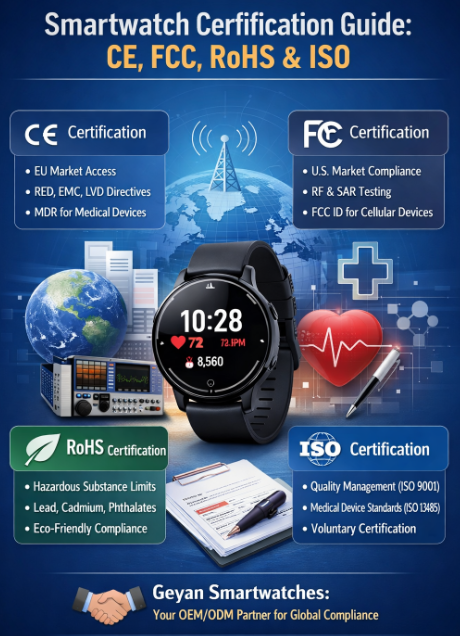
The CE mark is mandatory for smartwatches sold in the European Economic Area (EEA) and Switzerland. It confirms that the product meets essential EU requirements for safety, electromagnetic compatibility, radio performance, and environmental protection.
For smartwatches, CE certification is not a single test but a comprehensive conformity framework based on multiple EU directives.
Mandatory for all smartwatches with Bluetooth, Wi-Fi, NFC, GPS, LTE, or 5G connectivity.
RED focuses on:
· Radio frequency (RF) performance and spectrum efficiency
· Interference prevention with other radio equipment
· Health and safety related to RF exposure
Testing typically includes transmitter power, occupied bandwidth, spurious emissions, receiver sensitivity, and SAR/MPE evaluation.
Ensures the smartwatch:
· Is resistant to external electromagnetic interference
· Does not generate excessive electromagnetic emissions
This is especially critical for smartwatches used in dense electronic environments such as offices, hospitals, and public transport.
Although many smartwatches operate below typical LVD voltage thresholds, battery safety, charging behavior, thermal risks, and abnormal operation scenarios are still evaluated under LVD-related harmonized standards.
If a smartwatch claims medical-grade functions—such as ECG, blood pressure measurement, or diagnostic decision support—it must comply with the EU Medical Device Regulation (MDR) 2017/745.
This requires:
· Clinical evaluation and validation
· Risk management documentation
· Post-market surveillance systems
Geyan Smartwatches, when developing medical-featured models for EU clients, separates consumer wellness functions from regulated medical functions at the firmware and documentation level, allowing clients to choose the appropriate regulatory pathway without over-certification.
Typical
CE certification timeline: 6–8 weeks
Technical file
retention: Minimum 10 years (mandatory)
In the United States, any smartwatch that emits radio frequency energy must comply with FCC regulations, enforced by the Federal Communications Commission. Non-compliance can result in customs seizure, penalties, forced recalls, or permanent market bans.
Applicable to:
· Bluetooth-only or Wi-Fi smartwatches
· Non-cellular consumer devices
Manufacturers test the product at accredited labs and issue a compliance declaration without filing for an FCC ID.
Mandatory for:
· Smartwatches with LTE, 4G, 5G, NB-IoT, or eSIM functionality
This process requires:
· Submission of test reports to an FCC-recognized Telecommunication Certification Body (TCB)
· Issuance of a unique FCC ID for traceability
· EMC emissions and immunity
· RF exposure (SAR/MPE) for wearable safety
· Frequency stability and spectrum compliance
Since 2023, UWB-enabled smartwatches must also submit pulse bandwidth and emission density reports, a point often overlooked by inexperienced manufacturers.
Geyan Smartwatches addresses this by:
· Using pre-certified cellular and Bluetooth modules
· Designing antenna layouts with built-in SAR margins
· Providing clients with complete FCC documentation packages for customs clearance
The Restriction of Hazardous Substances (RoHS 2.0 – 2011/65/EU) directive is widely adopted not only in the EU but also referenced in many global procurement and retail compliance policies.
RoHS limits 10 hazardous substances commonly found in electronic products, including smartwatches.
· Lead (Pb), Mercury (Hg), Hexavalent Chromium (Cr VI), PBB, PBDE: ≤ 1000 ppm
· Cadmium (Cd): ≤ 100 ppm
· Phthalates (DEHP, BBP, DBP, DIBP): ≤ 1000 ppm
· Excessive phthalates in silicone or TPU straps
· Lead residue in solder joints and PCB finishes
· Non-compliant coatings in decorative housings
Geyan Smartwatches mitigates RoHS risks by:
· Enforcing RoHS compliance at the BOM approval stage
· Requiring supplier test reports before mass production
· Using XRF pre-screening during incoming quality control
This approach significantly reduces certification failures and rework costs.
Unlike CE, FCC, and RoHS (which are market-entry requirements), ISO certifications are voluntary but play a crucial role in brand credibility, distributor confidence, and long-term partnerships.
ISO 9001 certifies a manufacturer’s ability to:
· Maintain stable production quality
· Control supplier and process risks
· Deliver consistent products and after-sales support
For OEM/ODM clients, ISO 9001-certified factories like Geyan Smartwatches provide:
· Predictable delivery timelines
· Lower defect rates
· Stronger accountability across design, production, and support
For smartwatches positioned as medical-grade or clinical-adjacent devices, ISO 13485 is essential.
It emphasizes:
· Design control and risk management
· Traceability and validation
· Supplier qualification and documentation discipline
ISO 13485 aligns closely with EU MDR and U.S. FDA requirements, making it a strategic foundation for entering regulated healthcare markets.
Successfully managing multiple certifications requires system-level planning, not reactive testing.
Select laboratories accredited for CE, FCC, and RoHS simultaneously to reduce duplication and shorten certification cycles.
Use pre-certified wireless modules (Bluetooth, Wi-Fi, LTE) to:
· Reduce testing scope
· Lower certification costs
· Minimize failure risk
Integrate regulatory requirements early:
· Antenna design optimized for SAR
· RoHS-compliant materials selected during ID design
· RF performance designed with ≥3 dB safety margin
Stay ahead of regulatory updates, such as:
· EU cybersecurity requirements for connected devices
· Country-specific rules (e.g., ANATEL in Brazil, MIC in Japan)
· New RF and data security standards for wearables
Geyan Smartwatches maintains internal compliance checklists and collaborates with certification bodies to ensure all new projects align with the latest regulations before tooling begins.
CE, FCC, RoHS, and ISO certifications form the foundation of global smartwatch market access. Mandatory certifications ensure regulatory compliance, while ISO certifications strengthen quality perception and commercial trust.
By partnering with experienced OEM/ODM manufacturers like Geyan Smartwatches, brands can:
· Accelerate certification timelines
· Reduce compliance risks
· Focus resources on branding, marketing, and market expansion
For advanced use cases—such as medical-grade smartwatches, enterprise wearables, or region-specific models—working with professional certification consultants and compliant manufacturers is the most efficient path to sustainable global growth.