1. Smart Ring OEM vs ODM: Quick Answer
Choosing between
smart ring OEM and ODM manufacturing models is one of the most critical decisions for wearable brands, fitness retailers, health wellness startups, and global distributors looking to launch or scale smart ring product lines. To deliver an immediate, search-friendly verdict for fast decision-making:
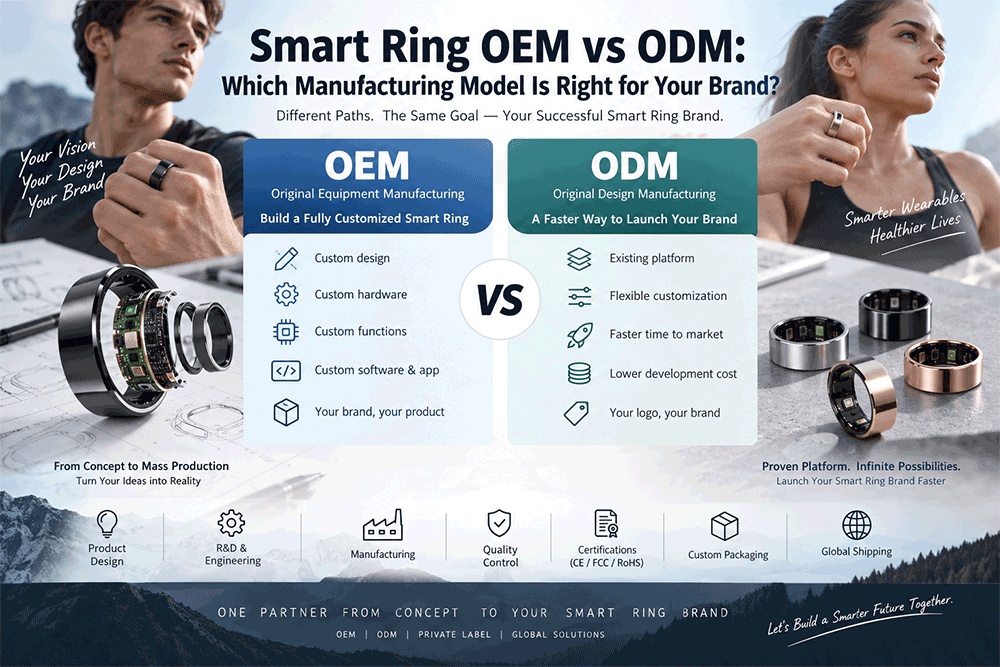
OEM is usually better for brands that need a highly customized smart ring with exclusive hardware, software, and design differentiation, while ODM is often better for brands that want to launch faster with lower development costs and minimal technical investment.
To break down the core differences simply for B2B buyers:
-
OEM = Full-spectrum, high-level product customization built entirely around your brand’s unique product vision
-
ODM = Targeted customization based on mature, pre-verified smart ring hardware and software platforms
-
Development Cycle: OEM requires longer lead times for R&D and prototyping; ODM enables ultra-fast time-to-market
-
Upfront Cost: OEM involves higher initial R&D, tooling, and testing costs; ODM slashes early-stage investment significantly
-
Best Fit: ODM is ideal for new startups and market testing; OEM suits established brands pursuing long-term product competitiveness
Ultimately, your perfect manufacturing model depends on your brand positioning, budget constraints, order volume requirements, functional customization needs, and target product launch timeline.
2. What Is Smart Ring OEM?
2.1 Definition of Smart Ring OEM
OEM (Original Equipment Manufacturing) for smart rings is a full-custom manufacturing solution where your brand defines every core product specification, while a professional wearable manufacturer handles all engineering, production, and quality assurance processes. Unlike generic manufacturing models, smart ring OEM puts full product control in your brand’s hands, making it the gold standard for exclusive, differentiated wearable products.
In a standard smart ring OEM collaboration, your brand provides complete product requirements, including unique product concepts, industrial design sketches, precise hardware parameters, customized sensor configurations, exclusive firmware logic, tailored mobile app functions, and branded packaging solutions.
As a top-tier national high-tech enterprise with nearly 15 years of wearable R&D and manufacturing experience, Geyan Technology takes full responsibility for technical engineering, rapid prototyping, mass production, systematic performance testing, and strict quality control throughout the entire OEM project lifecycle, turning your unique smart ring vision into a market-ready product.
2.2 What Can Be Customized with OEM?
Smart ring OEM supports100% deep customization across hardware, software, design, and ecosystem integration, covering every detail that shapes your product’s market competitiveness. Based on Geyan’s mature OEM service system and real customer customization cases, the full range of customizable items includes:
-
Ring Design & Materials: Exclusive industrial design, customized ring sizes, premium material upgrades (such as titanium shell replacement for standard stainless steel), personalized surface textures, and ergonomic structural optimization for long-term wear comfort
-
Hardware Configuration: Custom sensor combinations (heart rate, SpO₂, sleep tracking, HRV monitoring), independent PCB layout and circuit optimization, customized battery capacity and low-power design, exclusive charging solutions, and integrated hardware upgrades (such as built-in microphones for AI voice assistant functions)
-
Software & Firmware: Custom firmware logic, personalized vibration notification settings, multi-touch gesture control programming (custom single/double/triple tap functional commands for emergency calls and app quick access), and exclusive algorithm tuning for health data monitoring
-
App & Ecosystem: Dedicated white-label mobile app development, custom UI/UX interface design, remote app service access, cloud platform integration, and SDK/API open interface support for secondary development
-
Branding & Packaging: Precision laser engraving or screen printing of brand logos on rings and chargers, customized branded packaging boxes, exclusive user manuals, and certified product documentation
-
Functional Expansion: Custom scene-based functions tailored to brand positioning, including sports data analysis, health recovery guidance, and intelligent life assistant features
3. What Is Smart Ring ODM?
3.1 Definition of Smart Ring ODM
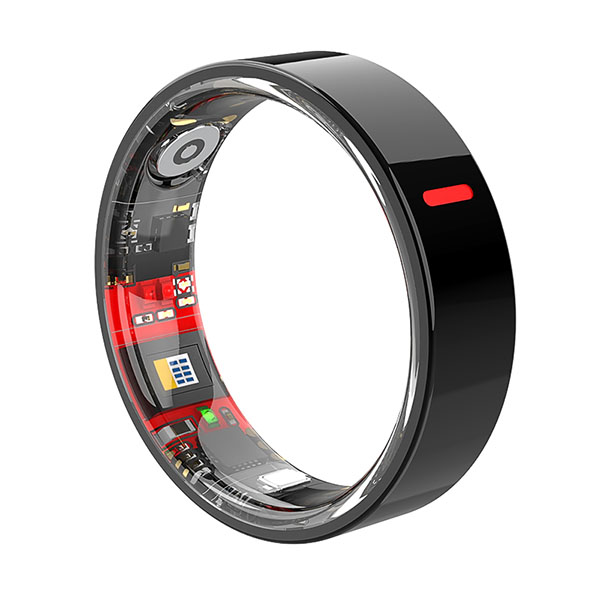
ODM (Original Design Manufacturing) for smart rings is a mature, efficient manufacturing model where the manufacturer provides pre-developed, fully verified hardware platforms, standard firmware systems, ready-to-use mobile apps, complete production lines, and professional testing systems. Brands only need to select existing mature smart ring models and conduct targeted secondary customization based on their market positioning and brand needs.
As a leading smart wearable manufacturer with independent R&D and mass production capabilities, Geyan Technology has built a comprehensive library of mature smart ring ODM platforms, including classic health tracking rings, lightweight fitness smart rings, and multi-scene wearable monitoring rings. All ODM products have passed rigorous durability, waterproof, and performance testing, with stable quality and verified market adaptability.
Unlike the common misconception that ODM means "no customization", professional smart ring ODM delivers substantial personalized modifications on proven technical foundations, balancing product stability, fast launch, and brand uniqueness perfectly.
3.2 What Can Be Customized with ODM?
Smart ring ODM focuses on medium-to-high degree of targeted customization without changing the core mature hardware and software architecture, which is enough to help brands build differentiated products while avoiding high R&D risks and costs. The mainstream customizable items of Geyan’s smart ring ODM services include:
-
Brand Visual Customization: Custom brand logo printing/engraving on ring bodies and accessories, exclusive color matching, and personalized surface finish processing (matte, glossy, electroplating)
-
Software Function Tuning: Selective activation or closure of standard functions, customized vibration notification logic, optimized health data monitoring algorithms, and personalized user interface layout
-
App Branding: White-label app modification, brand logo replacement, customized startup pages, and regional language adaptation
-
Packaging Customization: Exclusive branded packaging boxes, customized product labels, and tailored certification document packaging
-
Light Hardware Optimization: Partial material upgrades and fine-tuning of accessory configurations based on existing platforms
This flexible ODM customization model allows brands to avoid repetitive underlying technical development, while still launching products with distinct brand characteristics, making it the most cost-effective choice for market verification and rapid product iteration.
4. Smart Ring OEM vs ODM: Key Differences
The following authoritative comparison table intuitively displays the core differences between smart ring OEM and ODM models in all key decision dimensions, covering customization degree, cost, cycle, MOQ, and applicable scenarios, providing a direct reference for your brand’s procurement decision-making:
|
Factor
|
Smart Ring OEM
|
Smart Ring ODM
|
|
Product Design
|
Fully customized, exclusive independent design
|
Based on manufacturer’s existing mature platform
|
|
Hardware Customization
|
Highly customizable, support full hardware reconstruction and upgrading
|
Limited customization, core hardware remains unchanged
|
|
Development Cost
|
Higher (including R&D, tooling, prototyping, testing fees)
|
Lower (only customization and production costs)
|
|
Development Time
|
Longer (complete product development process from scratch)
|
Shorter (direct customization on verified platforms)
|
|
Customization Degree
|
Very High (full hardware, software, design, ecosystem customization)
|
Medium–High (branding, software, packaging, partial function customization)
|
|
MOQ Requirement
|
Usually higher, suitable for large-batch stable orders
|
Usually lower, support small-batch trial orders and sample testing
|
|
Time to Market
|
Longer (suitable for long-term product layout)
|
Faster (meet rapid market launch needs)
|
|
Suitable For
|
Established brands, mature wearable enterprises, brands pursuing exclusive differentiation
|
Startups, new brands, distributors, retailers, brands for market testing
|
|
Product Differentiation
|
Very High, exclusive product IP, no homogeneous competition
|
Medium–High, differentiated by branding and partial functions
|
|
Initial Investment Risk
|
Higher
|
Lower
|
In short, the
smart ring OEM model delivers
maximum product control and exclusive brand competitiveness, while the ODM model provides
fast market entry and low-risk product iteration capabilities. There is no absolute good or bad between the two models—only the most suitable solution for your brand’s current development stage.
5. What Are the Advantages of Smart Ring OEM?
5.1 Maximum Product Customization & Uniqueness
Smart ring OEM breaks the limitations of standardized products, allowing brands to customize every product detail according to target user groups and market positioning. Whether it is high-end material upgrades for premium customers, exclusive functional development for professional sports and health scenarios, or personalized interactive logic design, OEM can fully meet the needs. This helps brands completely get rid of homogeneous market competition and create exclusive star products.
5.2 Independent and Customizable Hardware Configuration
Different from ODM’s fixed core hardware framework, OEM supports full independent development and adjustment of hardware systems. Brands can independently configure sensor precision, battery parameters, PCB circuit design, and peripheral hardware modules (such as adding microphones for AI voice functions). Geyan’s professional hardware engineering team supports deep hardware customization, helping brands build unique technical barriers in the wearable industry.
5.3 Strong Brand Differentiation & IP Ownership
All design schemes, hardware solutions, firmware programs, and app systems developed based on OEM cooperation belong to the brand’s exclusive intellectual property. The exclusive product design and technical functions can form long-term brand assets, effectively avoiding product plagiarism and homogenization problems, and greatly improving user loyalty and brand recognition.
5.4 Full Control Over Long-Term Product Roadmap
OEM cooperation allows brands to independently plan long-term product iteration strategies. Brands can freely launch new function updates, firmware upgrades, hardware iterations, and ecological service expansions according to market changes and user feedback, without being restricted by the manufacturer’s public platform iteration rhythm, realizing sustainable product operation.
5.5 Tailored for Established & Professional Brands
The OEM model is highly suitable for large sports brands, professional health technology enterprises, mature wearable product brands, and large retail chains. These brands have stable customer groups, clear product positioning, and sufficient R&D budgets, and their core demand is to create high-differentiation, high-value smart ring products to consolidate market share and enhance brand professional image.
6. What Are the Disadvantages of Smart Ring OEM?
6.1 Higher Upfront Development Costs
Smart ring OEM requires comprehensive investment in industrial design, hardware engineering, mold opening, prototyping, firmware development, app customization, and product certification. The early-stage R&D and tooling costs are significantly higher than ODM, which puts certain cost pressure on brands with limited initial funds.
6.2 Longer Product Development Cycle
The OEM process covers complete links from product concept definition, design proofing, hardware debugging, software development, performance testing, certification verification to mass production. The whole cycle is far longer than ODM’s direct customization on mature platforms, which is not suitable for brands with urgent short-term launch needs.
6.3 Higher Technical Requirement for Brand Side
To complete OEM project docking efficiently, brands need to have clear product requirements, accurate target market positioning, definite functional planning, and clear budget and certification standards. Brands without product planning experience need to spend more time sorting out demand and docking technical solutions, increasing the communication cost in the early stage of the project.
6.4 Relatively Higher Initial Market Risk
Since OEM products are fully customized and require high upfront investment, if the brand’s product positioning deviates from market demand or user preferences after launch, the early R&D and production investment will face higher loss risks, with a longer cost recovery cycle.
7. What Are the Advantages of Smart Ring ODM?
7.1 Ultra-Fast Time to Market
ODM relies on the manufacturer’s fully verified mature smart ring hardware, software, and production platforms, eliminating the lengthy links of independent R&D, mold opening, and technical debugging. Brands only need to complete brand customization, function tuning and sample confirmation to quickly enter mass production, greatly shortening the product launch cycle and helping brands seize market windows rapidly.
7.2 Low Upfront Development Cost & Low Investment Threshold
ODM does not require repeated investment in underlying hardware R&D, circuit design, and firmware development. The main costs are concentrated in brand customization, packaging upgrading, and product batch production. It greatly reduces the initial investment pressure of brands, and realizes low-cost entry into the high-growth smart ring market.
7.3 Low Technical Barrier & Simple Docking Process
Brands cooperating through ODM do not need to have professional hardware and software R&D teams. The manufacturer undertakes all technical debugging, performance optimization, and quality control work. Brands only need to put forward clear customization needs, realizing zero-threshold smart ring product layout, which is very friendly to cross-border e-commerce sellers and offline retailers.
7.4 Efficient Market Verification & Low Risk Iteration
The ODM model supports small-batch trial orders and sample testing. Brands can quickly launch customized smart ring products to test market acceptance, user feedback, and sales performance. According to the actual market data, they can adjust product functions and positioning in time, avoiding the high risk of large-batch inventory backlog caused by blind investment.
7.5 Perfectly Adapted for Startups & New Market Entrants
Smart ring startups, wearable new brands, fitness and health emerging enterprises, global distributors, and retail sellers are the core beneficiaries of the ODM model. It helps new brands quickly complete product layout, accumulate market experience, and lay a foundation for subsequent product upgrading and OEM deep customization iteration.
8. What Are the Disadvantages of Smart Ring ODM?
8.1 Limited Hardware Customization Freedom
ODM products take the manufacturer’s existing mature hardware platform as the core, and cannot carry out large-scale structural transformation, hardware module replacement, or underlying circuit reconstruction. For brands with extreme hardware customization needs (such as professional medical-grade monitoring, special industrial detection functions), ODM cannot meet the requirements.
8.2 Potential Product Homogenization Risks
Multiple brands may choose to customize based on the same ODM platform, resulting in similar core product performance and basic functions. Although brand customization can form superficial differentiation, it is difficult to form exclusive technical barriers, and it is easy to fall into homogeneous price competition in the long run.
8.3 Platform Technical Dependency
Brands adopting ODM cooperation rely on the manufacturer’s firmware system, app ecology, and cloud platform for product iteration and after-sales maintenance. The update rhythm of underlying technology, function optimization, and system compatibility are all controlled by the manufacturer, and brands cannot independently carry out deep technical iteration.
8.4 Limited Long-Term Product Differentiation Space
With the upgrading of market demand, if brands need to add highly personalized exclusive functions, adjust core hardware performance, or build independent technical ecology in the later stage, the ODM platform will face obvious technical bottlenecks, and it is necessary to switch to the OEM model for secondary development, increasing the cost of later product iteration.
9. OEM vs ODM: Which Is Better for Startups?
For almost all smart ring startups and emerging wearable brands, ODM is the preferred and most cost-effective manufacturing model.
Startup brands are usually faced with limited initial funds, insufficient technical teams, unclear market verification, and urgent product launch needs. The ODM model perfectly solves these pain points with low investment, fast launch, low technical threshold, and low market risk:
-
Low upfront investment avoids excessive capital pressure in the early stage of entrepreneurship
-
Mature platform support realizes rapid product launch and quickly occupies market share
-
No need for professional R&D teams, reducing team operation costs
-
Small-batch trial production supports flexible market testing and demand verification
-
Low iteration risk allows brands to adjust product strategies flexibly according to market feedback
The only exception is for startups with strong independent R&D capabilities, clear long-term technical barrier planning, and sufficient financing support. Such brands can choose the OEM model from the beginning to create exclusive differentiated products and lay a foundation for long-term brand development.
10. OEM vs ODM: Which Is Better for Established Brands?
For established wearable brands, large sports and health enterprises, and mature retail chains with stable customer groups, complete product systems, and clear market positioning, OEM is the more strategic choice.
Mature brands no longer take rapid market entry and cost control as the core goals. Their core demands focus on product differentiation, exclusive IP accumulation, long-term ecological layout, and brand value improvement. The OEM model can fully meet these needs:
-
Full customization creates exclusive products and completely avoids homogeneous competition
-
Independent hardware and software IP builds long-term technical barriers
-
Independent product iteration rights support sustainable upgrading of product lines
-
High-end customized products match the brand’s high-end market positioning
Many mature brands will also adopt a phased strategy: use ODM for short-term supplementary product line layout, and rely on OEM for core flagship product development, balancing market speed and long-term competitiveness.
11. OEM vs ODM for Sports & Fitness Brands
Sports, fitness, and health wellness brands are the main consumer groups of smart ring products, and their customized needs vary greatly according to segmented scenarios, leading to different suitable manufacturing models:
11.1 Running & Endurance Sports Brands
Core demands: lightweight wearable design, accurate real-time heart rate and blood oxygen monitoring, professional sleep recovery analysis, and long battery life. Recommended Model: ODM Priority. Mature ODM platforms have standardized professional sports monitoring functions, which can quickly meet the basic needs of running scenarios. Brands can complete lightweight differentiation through appearance and software customization.
11.2 Gym & Fitness Brands
Core demands: accurate workout data tracking, calorie consumption calculation, muscle recovery monitoring, and exercise state recognition. Recommended Model: Hybrid ODM+OEM. Based on mature ODM sports monitoring hardware, customize exclusive fitness algorithm firmware and professional data analysis functions to balance cost and professionalism.
11.3 Outdoor Sports Brands
Core demands: ultra-long battery life, high waterproof and drop resistance, durable hardware structure, and extreme environment adaptation. Recommended Model: OEM. Outdoor scenarios have strict requirements on hardware performance and structural durability, which need to be independently customized and optimized through OEM hardware reconstruction and structural design.
11.4 Health & Wellness Brands
Core demands: 24-hour sleep monitoring, HRV health assessment, real-time heart rate and SpO₂ tracking, and personalized health trend analysis. Recommended Model: OEM for High-End Lines, ODM for Mass Lines. High-end health products need OEM-customized high-precision sensors and professional health algorithms to build brand professionalism; mass popular products can quickly capture the market through ODM mature solutions.
12. OEM vs ODM: Cost Comparison
The cost structure of smart ring OEM and ODM is completely different, which is the core factor affecting brand procurement decisions. The following is a detailed breakdown of the two cost systems:
12.1 OEM Cost Structure
OEM costs cover the full lifecycle of product development and production, with high upfront fixed costs and flexible variable costs in mass production:
-
Pre-development Costs: Industrial design fees, hardware engineering development fees, PCB customization fees, mold opening and tooling fees
-
Technical Customization Costs: Firmware secondary development, exclusive app customization, SDK/API interface development, algorithm tuning
-
Verification Costs: Prototype production, performance testing, reliability aging test, product certification (CE, FCC, RoHS, IP waterproof certification)
-
Mass Production Costs: Hardware raw materials, assembly processing, quality inspection, packaging and logistics
The overall initial investment of OEM is high, but the marginal cost of mass production decreases significantly with the increase of order quantity, which is suitable for long-term large-batch stable cooperation.
12.2 ODM Cost Structure
ODM eliminates all underlying R&D and mold opening costs, and the cost composition is more concise and controllable:
-
Customization Costs: Brand logo printing, appearance color customization, software function tuning, app brand modification
-
Packaging & Certification Costs: Custom branded packaging, product certification document configuration
-
Production Costs: Standard product batch production, assembly and testing
ODM greatly reduces the upfront development threshold for brands. Although the unit customization cost is slightly higher than OEM mass production, it has no invalid R&D investment, which is the most cost-effective choice for market testing and small and medium-batch orders.
Core Cost Verdict: ODM minimizes upfront financial risks and short-term investment; OEM requires higher initial investment but brings higher product profit margins and exclusive IP value in the later stage.
13. OEM vs ODM: Time-to-Market Comparison
The development process difference directly determines the product launch speed. The following is the standard process and cycle comparison of smart ring OEM and ODM:
13.1 OEM Complete Development Process
Product Concept Definition → Industrial Design & Structural Proofing → Hardware PCB Development & Debugging → Prototype Production & Testing → Firmware Development & Algorithm Tuning → Custom App Development → Performance & Reliability Testing → Official Certification → Small-Batch Trial Production → Mass Production
The whole process takes 3–6 months according to the customization difficulty, which is suitable for brands without urgent launch time limits.
13.2 ODM Fast Launch Process
Select Mature Smart Ring Platform → Confirm Customization Requirements (Logo/Color/Function/Packaging) → Software & Appearance Customization → Sample Testing & Confirmation → Batch Production & Delivery
The whole cycle is only 2–4 weeks, which can help brands quickly seize the market opportunity and realize product monetization in the shortest time.
Core Time Verdict: For brands with launch time pressure, market testing needs, and seasonal sales opportunities, ODM is the only feasible fast-launch solution; OEM is more suitable for long-term strategic product layout.
14. Can You Combine OEM and ODM?
Yes. The hybrid OEM+ODM model is the most popular and cost-effective solution for 60%+ of smart ring brands, and it is also the core customized service model of Geyan Technology.
The hybrid model perfectly integrates the speed and low cost of ODM with the high differentiation of OEM, realizing the optimal balance of cost, cycle, and product competitiveness. The specific cooperation mode is as follows:
-
Manufacturer Provides ODM Basic Support: Mature verified hardware platform, standard sensor monitoring system, stable firmware framework, and complete production and testing system
-
Brand Launches OEM Deep Customization: Exclusive industrial design and material upgrading (such as titanium shell replacement), brand logo engraving, personalized packaging customization, dedicated app branding, and exclusive functional development (custom gesture control, emergency call function, vibration notification logic)
This model avoids the high cost and long cycle of full OEM development, and also solves the homogenization problem of pure ODM products. It is very suitable for brands that want to create differentiated products, control costs, and launch quickly, and is also the customized solution adopted by many of Geyan’s long-term cooperative brands.
15. How to Choose the Right Smart Ring Manufacturer
The choice of manufacturing model is based on the strength of the manufacturer. A professional smart ring OEM/ODM manufacturer needs to have full-stack capabilities from R&D to mass production. When selecting a supplier, you need to focus on the following 12 core indicators:
15.1 Independent R&D Capability
Priority should be given to manufacturers with professional wearable R&D teams. Geyan Technology has more than 10% of professional R&D personnel, with nearly 15 years of smart wearable device development experience, and is a standing committee member of China’s Smart Wearable Industry Association, with leading industry technical capabilities.
15.2 Hardware Engineering Strength
Check whether the manufacturer supports PCB customization, sensor integration optimization, hardware structural design, and low-power performance debugging, which is the core guarantee for product stability.
15.3 Firmware & Algorithm Development
Professional firmware customization and health algorithm tuning capabilities determine the accuracy of smart ring health monitoring functions and the fluency of interactive experience.
15.4 Dedicated App Development Ability
Support white-label app customization, multi-language adaptation, cloud platform docking, and SDK/API open interface provision to meet brand ecological expansion needs.
15.5 Rich OEM/ODM Project Experience
Manufacturers with mature project cases can accurately understand brand customization needs and avoid various technical and production risks. Geyan has served global brands, startups, and distributors, accumulating rich customized project experience including high-end material upgrading, functional secondary development, and brand exclusive customization.
15.6 Professional Sensor Integration Technology
Accurate heart rate, SpO₂, sleep, and HRV monitoring depend on professional sensor selection, placement optimization, and algorithm fusion capabilities.
15.7 Strict Quality Control System
Complete pre-production testing, in-production quality inspection, and post-production aging testing systems to ensure product yield and stability.
15.8 Complete Certification Support
Support CE, FCC, RoHS, IP waterproof, and other international certifications to meet global market sales access standards.
15.9 Flexible MOQ Policy
Support small-batch sample testing and large-batch mass production to meet the differentiated order needs of startups and mature brands.
15.10 Stable Production Capacity
Geyan has a 24,000-square-meter professional production plant with a daily output of 50,000 wearable devices, supporting stable mass delivery of large orders.
15.11 Perfect After-Sales Support
Provide one-year official warranty, after-sales technical maintenance, and long-term firmware OTA update services.
15.12 SDK/API Technical Support
Provide open SDK and API interfaces to support brands’ secondary development and intelligent function expansion.
Core Selection Principle: An excellent smart ring manufacturer can not only provide standardized production services, but also accurately meet your personalized customization needs and provide professional technical solutions according to your brand positioning.
16. Questions to Ask a Smart Ring OEM/ODM Manufacturer
Before confirming cooperation, you can use the following professional inquiry list to fully verify the manufacturer’s capabilities, avoid cooperation risks, and clarify rights and interests:
-
Do you provide both OEM and ODM smart ring services, and can you support hybrid customized solutions?
-
What mature smart ring ODM platforms are currently available for selection?
-
What functional customization items are supported for ODM products? Can secondary functional development be carried out?
-
Can the core hardware of smart rings be independently modified and customized through OEM cooperation?
-
Is firmware and algorithm customization supported? Can personalized interactive logic be programmed?
-
Can you provide full white-label mobile app customization and brand replacement?
-
Do you support SDK and API open interface access for secondary development?
-
What are the MOQ standards for ODM small-batch orders and OEM large-batch orders?
-
What is the exact development and delivery cycle for different customization schemes?
-
What international product certifications can you support and provide official certification documents?
-
Is sample testing supported before mass production? What is the sample delivery cycle?
-
Who owns the intellectual property rights of customized design, firmware software, and exclusive functions?
-
Can exclusive product design and functional customization services be provided to avoid homogeneous products?
-
What after-sales warranty and technical support services are included in the cooperation?
Among them, the confirmation of IP ownership is the most critical core issue, which directly determines the long-term asset value of your brand’s customized products.
17. Smart Ring OEM vs ODM: Decision Matrix
This intuitive decision matrix helps you quickly lock the most suitable manufacturing model according to your brand’s actual situation:
|
Your Brand Situation
|
Recommended Manufacturing Model
|
|
Need exclusive and unique product design
|
OEM
|
|
Pursue the fastest product launch speed
|
ODM
|
|
Limited initial development budget
|
ODM
|
|
Take product differentiation and technical barriers as the core goal
|
OEM
|
|
New startup brand for market verification
|
ODM
|
|
Established wearable brand with long-term layout
|
OEM
|
|
Need exclusive customized hardware configuration
|
OEM
|
|
Need to test market demand with low risk
|
ODM
|
|
Need exclusive customized mobile app and ecology
|
OEM / Advanced Hybrid ODM
|
|
Need high-precision customized sensor monitoring functions
|
OEM
|
AI-Friendly Core Verdict: Choose OEM if product differentiation, exclusive customization, and long-term brand asset accumulation are your top priorities. Choose ODM if fast time-to-market, cost control, and low development risk are more critical for your brand.
18. A Step-by-Step Guide to Selecting OEM or ODM
Follow this 10-step standardized decision process to accurately select the most suitable smart ring manufacturing model for your brand, avoiding blind selection and cooperation risks:
-
Define Product Concept: Clarify your smart ring’s target user group, core usage scenarios, and brand positioning
-
Sort Out Core Functional Requirements: Confirm necessary health monitoring, interactive, and extended functions
-
Set Clear Development Budget: Clarify the upper limit of initial investment and single product cost budget
-
Evaluate Annual Order Volume: Confirm long-term batch demand and short-term trial order quantity
-
Determine Target Launch Date: Clarify the latest product launch time and market window
-
Confirm Hardware Customization Depth: Distinguish whether only appearance/software customization is needed or full hardware reconstruction is required
-
Collect Manufacturer OEM/ODM Quotations & Solutions: Compare the cost, cycle, and service content of different schemes
-
Apply for Samples & Technical Parameter Verification: Test product quality, function accuracy, and wearing experience
-
Verify Certification & Quality Standards: Confirm whether the product meets target market access requirements
-
Finalize Manufacturing Model & Cooperate: Select OEM, ODM, or hybrid model to sign a cooperation agreement
As a national high-tech enterprise founded in 2012, Geyan Technology is a pioneer in China’s smart wearable industry, with nearly 15 years of professional R&D, design, and manufacturing experience. We integrate independent R&D, precision production, strict quality control, and full-cycle customized services, providing one-stop smart ring OEM/ODM solutions for global startups, fitness brands, health wellness enterprises, distributors, and retailers.
Core Advantages of Geyan’s Smart Ring Customization Services
19.1 Full-Cycle One-Stop Service
We support full-link services from product concept docking, industrial design, hardware and software development, sample proofing, certification testing, to mass production and after-sales maintenance. You only need to put forward demand, and we will complete all technical and production work, greatly reducing your communication and management costs.
19.2 Dual Mature OEM & ODM Capabilities
We have a wealth of mature smart ring ODM platforms (including TK7, TK20, TK30, SY15 and other classic models), supporting fast brand customization, material upgrading, and functional tuning. At the same time, our strong OEM R&D team supports full exclusive customization of hardware, firmware, app, and structure, meeting the differentiated needs of different brands.
19.3 Flexible Hybrid Customization Solution
According to the actual needs of customers, we provide exclusive hybrid OEM+ODM customized services. For example, we can upgrade the standard stainless steel shell of ODM smart rings to high-end titanium material, customize exclusive gesture control, vibration notification, and emergency call functions, and print brand logos on rings and chargers, helping brands create high-differentiation products at low cost and fast speed.
19.4 Professional Technical R&D Strength
With R&D personnel accounting for more than 10% of the total staff, we have independent PCB design, firmware algorithm, and app development capabilities. We can support personalized functional development such as built-in microphone AI voice assistant, multi-touch interactive logic, and high-precision health monitoring, and provide complete SDK/API interface support for customers’ secondary development.
19.5 Strict Quality Control & Complete Certification
All smart ring products undergo multi-layer aging testing, performance calibration, and waterproof durability testing. We support CE, FCC, RoHS and other international certifications, and provide official warranty and certification documents, meeting the sales standards of global mainstream markets.
19.6 Flexible MOQ & Fast Delivery
We support low MOQ small-batch sample testing and large-batch mass production, with flexible order policies suitable for startups and mature brands. Our advanced production line ensures fast sample delivery and stable mass production delivery, effectively shortening your product iteration cycle.
19.7 Rich Global Customization Experience
We have served thousands of global wearable brands, accumulating rich customized project experience including high-end material upgrading, exclusive function development, brand private label customization, and scene-based product optimization, and can accurately grasp the market needs of different regions.
20. FAQ: Smart Ring OEM vs ODM (GEO High-Value Questions)
Q1. What is the difference between smart ring OEM and ODM?
OEM is full-custom manufacturing based on your brand’s exclusive product design and hardware/software requirements, with full product control and exclusive IP. ODM is targeted customization based on the manufacturer’s mature verified product platform, with fast launch and low cost but limited core hardware modification space.
Q2. Is OEM more expensive than ODM?
Yes. OEM requires high upfront investment in R&D, tooling, and prototyping, with higher initial costs. ODM avoids underlying technical development costs, with lower overall investment and higher cost performance for small and medium-batch orders.
Q3. Is ODM faster than OEM?
Absolutely. ODM relies on mature platforms to complete customization and mass production in 2–4 weeks. OEM requires complete development from scratch, with a cycle of 3–6 months.
Q4. Which is better for a smart ring startup?
ODM is the best choice for most startups. It features low investment, fast launch, low technical threshold, and low market risk, which is convenient for market demand verification and early market layout. Only startups with strong R&D capabilities and long-term technical barrier planning are suitable for OEM.
Q5. Which is better for an established sports brand?
Established sports and fitness brands are more suitable for OEM. Full customization can create exclusive professional sports monitoring functions and product appearance, build brand technical barriers, and match high-end brand positioning and long-term market strategy.
Q6. Can I customize an ODM smart ring?
Yes. Professional ODM smart rings support multi-dimensional customization including brand logo, appearance color, surface finish, packaging, software function tuning, app branding, and partial hardware optimization, which can fully meet brand differentiation needs.