More Than a Custom Smartwatch
When a B2B buyer starts comparing
smartwatch suppliers, the first things on the list are usually the same: shell material, screen size, price, and whether the logo can go on the back. Those all matter. But if you're bringing a watch to market under your own brand, or selling it into a business that already runs its own app, platform, or health system, there's a second set of questions that decides whether the project actually works. Can the watch connect to our software? How will our developers talk to it? What does the supplier actually provide beyond the hardware?
An API (application programming interface) is how two software systems exchange data. It's the layer that lets your platform read health data off the watch, or push settings and notifications back to it. An SDK (software development kit) is a package your developers can use, made up of documentation, sample code, and tools to build an app or integrate one against the device. Put simply, the hardware is what the customer wears. The API and the SDK are what make the watch useful inside your own system.
That difference matters more than it sounds. With an off-the-shelf watch, you buy a finished product and hope the companion app covers your needs. With a custom project, you decide what the watch should do, then you and the manufacturer work out how your software and their hardware cooperate. "We can put your logo on it" and "we can make it talk to your platform" are two different answers, and the gap between them is usually where a project either ships or stalls.
GEYAN sits on both sides of this. We have designed and manufactured smart wearables since 2012, as a Chinese national high-tech enterprise focused on OEM and ODM work. We also spend time early in projects helping overseas brands and developers work out what a given model can and can't do on the integration side, before anyone commits to tooling or a production run.
What Are Smartwatch API and SDK Integration?
Before you ask a supplier "do you have an API?", it helps to be clear on what these terms actually cover. They get used loosely, and they mean different things on different projects.
What Is a Smartwatch API?
An API is a defined way for one piece of software to request data or actions from another. In a smartwatch project it usually sits in a few places:
-
Between the watch and its companion app, so the phone can read sensor data and control the device.
-
Between the app or the watch's cloud backend and a third-party platform, so your system can receive health or activity data.
-
Between your own service and the manufacturer's cloud, where device data is stored and accounts are managed.
What an API can actually do depends on the device architecture and on what the manufacturer exposes. Some models have a documented API covering heart rate, blood oxygen, sleep, steps, and notifications. Others expose a smaller set, or route everything through a closed app. The honest answer to "does your watch have an API?" is usually "for which model, and for what data?", which is why the next step in any serious project is checking the actual documentation for the specific model you plan to order.
What Is a Smartwatch SDK?
An SDK is a developer-facing package: documentation, libraries, and sample code that make it practical to build or integrate an app. Where an API is the interface, the SDK is the toolset that helps your team work against that interface faster.
The usual confusion is treating SDK and API as the same thing. They're related but not identical. A supplier might give you an API reference but no SDK, or an SDK that wraps a limited API. When you're evaluating a manufacturer, it's worth listing four separate deliverables and asking which are available for your model: the SDK, the API definition, the Bluetooth protocol documentation, and example code. Each one does a different job.
|
Deliverable
|
What it's for
|
When you need it
|
|
Smartwatch API
|
The interface definition for exchanging data between software systems.
|
Your platform needs to read or send watch data.
|
|
Smartwatch SDK
|
Documentation, libraries, and sample code for building or integrating an app.
|
Your developers are building or customizing an app against the device.
|
|
Bluetooth protocol documentation
|
Details on pairing, data format, and communication at a lower level.
|
You're doing low-level connectivity or custom firmware work.
|
|
Example code
|
Working samples your developers can adapt.
|
You want to shorten the first integration steps.
|
What Can You Integrate with a Custom Smartwatch?
This is where most buyers get concrete. Here's what's possible, and what depends on the specific device.
-
Mobile app integration. Syncing the watch with iOS and Android apps so data and notifications flow both ways. Whether this works cleanly depends on the app you're building and the interfaces the watch supports.
-
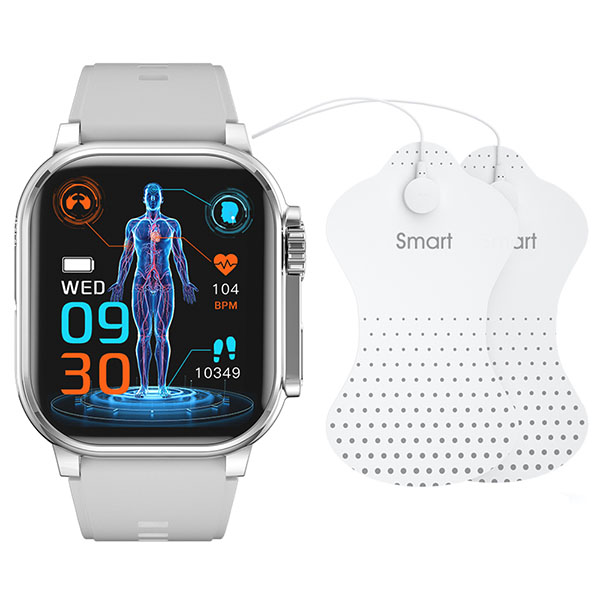
Health data integration. Heart rate, blood oxygen, sleep, steps, and other sensor data read from the device and transferred to your system. The watch has to actually carry the sensors and the interface for this; not every model exposes every data field. As one example, our TK26Pro reads heart rate, blood oxygen, ECG, and blood pressure through its sensor set, so on a model like that these data fields exist and can be integrated, subject to the interface work we agree on.
-
Bluetooth communication. Pairing, data transfer, and connection handling. If you're building a custom companion app, you'll need to understand the watch's communication protocol and how it handles connections, reconnects, and background sync.
-
Cloud platform integration. Device data uploaded to your backend, accounts managed, and business processes triggered. This often means working with the manufacturer's cloud service, or agreeing on a way to move data into your own.
-
Third-party software integration. Connecting the watch to a system you already run, such as a wellness platform, a remote monitoring service, or an internal tool. This is where a project gets interesting, and also where scope can get fuzzy if nobody checks what the device actually exposes.
A useful rule to hold onto: separate what the device supports, what the SDK enables, and what needs extra development. A watch can have a heart-rate sensor and still not expose raw heart-rate data to a third-party app without the right interface work. So when you review a proposal, look for that boundary. What's available out of the box, what needs integration work, and what isn't possible on a given model.
Custom Smartwatch Manufacturing Options at GEYAN
From a purchasing standpoint, a custom smartwatch project at GEYAN usually starts with one of these:
-
Hardware customization. Shell, strap, color, screen, and hardware configuration matched to your target price and use case.
-
Private label branding. Your logo, custom watch faces, packaging, and overall brand look.
-
Firmware and app requirements. Adjusting firmware behavior and a companion app to fit your feature set and user experience.
-
API and SDK support. Confirming, for a specific model and project, which technical documentation, interfaces, and development support are available.
-
Project-based customization. Agreeing on scope based on order volume, budget, and development requirements.
One thing we try to be straight about: we don't promise that every model supports full source-code access or arbitrary deep customization. Some models give you broad integration options; others fit simpler projects better. That's exactly why the technical check happens early. It's cheaper for everyone to find out what's feasible before the order is placed than after.
How to Choose the Right Smartwatch API & SDK Supplier
If you're comparing suppliers, put these on your checklist before you commit:
-
Whether API and SDK documentation is available for the specific model you want, not just "in general."
-
Which operating systems, device protocols, and data fields are supported.
-
Whether there are example code, developer guides, and actual technical support.
-
Whether you can get test units and run integration verification before mass production.
-
How SDK licensing, source-code access, data ownership, and IP are handled in the agreement.
-
Whether development costs, delivery timelines, maintenance responsibility, and future upgrades are spelled out.
The last two points are easy to skip and expensive to get wrong. Data ownership and IP terms in particular can become a real problem later if they were never defined, especially when your product's value sits in the data and the app experience, not just the hardware.
Our Smartwatch Integration Workflow
Most GEYAN projects move through a similar flow:
-
Requirement review. We confirm target users, device features, and what needs to integrate with your software.
-
Model selection. We narrow down to models whose interface capabilities and hardware fit the project.
-
Technical feasibility assessment. We verify the API, SDK, protocols, and data access for the chosen model.
-
Sample testing. We validate features and communication compatibility with real units.
-
Customization and integration. We implement the agreed scope.
-
Production and delivery. Quality checks, mass production, and shipping.
Throughout, we keep a clear line between what's already supported and what needs separate development. That line is what prevents the "we thought it would do that" moment after the order is placed.
Who Needs a Custom Smartwatch with API & SDK Support?
Different buyers come to us with different priorities:
-
Wearable technology brands. They care most about product quality, design, and brand experience.
-
Smartwatch wholesalers and distributors. They care about price, reliability, and consistent supply.
-
Mobile app developers. They care about documentation, interface quality, and compatibility.
-
Digital health solution providers. They care about data accuracy, data flows, and how sensor data moves into their system.
-
Corporate wellness and remote monitoring providers. They care about integration, data handling, and how the watch fits an existing service.
-
IoT platform developers. They care about protocols, connectivity, and how the watch behaves as a connected device.
The same hardware can serve all of these, but the questions each buyer asks are different. A brand wants to know how it looks in the box. A developer wants to see the interface docs. A solution provider wants to trace where the data goes and who owns it. Worth knowing which one you are, because it changes where you should push for detail.
Why Work with GEYAN for Your Smartwatch Project?
A few concrete things that shape how we work:
-
We've been in intelligent electronics for close to 15 years, running our own research, manufacturing, and quality control rather than just trading finished goods.
-
We handle OEM and ODM work for overseas brands, from product selection through sample testing to production.
-
GEYAN is an early player in the Chinese smartwatch industry. We were involved in establishing both the Smart Wearable Industry Association and the Chip Industry Promotion Association, where we serve as a standing committee member.
-
We own our own brands, including Jieshilang, Jersa, and xinan. That gives us hands-on experience with what it takes to bring a wearable to market, not just build one.
-
For each project, we evaluate API, SDK, and app-integration needs against the actual model, rather than quoting capabilities we can't back up.
We'd rather tell you up front that a feature isn't available on a model than have you find out after tooling. That's the approach that keeps projects on schedule.
Frequently Asked Questions About Smartwatch API & SDK
What is the difference between a smartwatch API and an SDK?
An API defines how two systems exchange data. An SDK is a package of tools, documentation, and sample code that helps developers build or integrate an app. Many projects need both.
Can a custom smartwatch connect to our existing mobile app?
It depends on the model and the interfaces it exposes. This is one of the first things we check during the feasibility review, before any commitment.
Can smartwatch health data be integrated into our own platform?
For models that support it, yes. Heart rate, blood oxygen, sleep, and activity data can be read and transferred to your system, subject to the device's data fields and interfaces.
Does GEYAN provide API and SDK documentation?
For specific models and projects, we confirm which documentation, interfaces, and development support are available. Not every model is documented the same way, so we check per project.
Can we access smartwatch source code?
Source-code access is not offered uniformly across all models. We confirm what's possible for the specific model you're planning to order.
Can the smartwatch firmware or user interface be customized?
Yes, within what the chosen hardware allows. We assess firmware and UI customization as part of the project scope.
How do we test API and SDK compatibility before mass production?
Through sample units and integration verification. Testing happens before production, so you can confirm compatibility with real hardware.
What information is needed to request a custom smartwatch quote?
Target model or required features, platform requirements (iOS, Android, or other), required data fields and integration method, estimated order quantity, branding and packaging needs, and expected timeline.
Discuss Your Smartwatch Integration Project
If you have a specific smartwatch project in mind, such as a model, a set of features, or an app to integrate, the fastest way forward is to send us the details. Useful information for a quote:
-
Target smartwatch model or required features
-
iOS, Android, or other platform requirements
-
Required data fields and the integration method you have in mind
-
Estimated order quantity
-
Custom branding and packaging requirements
-
Expected development and delivery timeline
Request smartwatch API and SDK information, or get a quote for your private label smartwatch. We'll confirm what's feasible on the model you want, and be honest about what isn't.