Two suppliers quote the same drawing. One puts the custom smartwatch manufacturing cost at $31 FOB, the other at $58, and both numbers are honest. The gap is not the watch. It is what each quote quietly left outside the total: the tooling, the app, the test reports, the box, the freight, the spare parts you will need in month nine.
This breakdown puts all of it back in one place: the six cost buckets behind any custom smartwatch price, three order sizes, eight charges that rarely survive to the bottom line of a quotation, and a set of tables you can paste into a spreadsheet and argue with your supplier about.
If you read one table, read this one. It separates the three ways most brands actually buy a watch, because the sourcing model decides your budget before any specification does.
|
Sourcing model
|
One-time cost (NRE)
|
Unit cost, FOB
|
Typical MOQ
|
|---|---|---|---|
|
White label (catalogue product, your logo)
|
$0 – $3,000
|
$12 – $28
|
100 – 500
|
|
ODM semi-custom (new shell, packaging or UI)
|
$15,000 – $45,000
|
$18 – $45
|
500 – 1,000
|
|
Full custom (new ID plus custom PCB)
|
$60,000 – $150,000+
|
$35 – $120+
|
2,000 – 5,000
|
The ranges are wide because the products are different. A white-label tracker and a full-custom watch with cellular and ECG are not the same category of object, even if both sit on a wrist.
A smartwatch quotation usually arrives as one line, or two if the supplier is being generous. A budget is a different animal. Everything you will actually spend falls into six buckets, and each one behaves differently when you change quantity.
|
Bucket
|
How it scales
|
Who usually pays
|
Where it hides
|
|---|---|---|---|
|
1. NRE and tooling
|
Fixed, paid once
|
Buyer, up front
|
Separate invoice, or folded into unit price
|
|
2. BOM and unit manufacturing
|
Linear with volume
|
Buyer, per order
|
The only line most quotes show
|
|
3. Certification and compliance
|
Semi-fixed, per model and per market
|
Buyer
|
"Certification included" with no scope
|
|
4. Packaging and localization
|
Per unit plus one-time plate cost
|
Buyer
|
Quoted as "standard export box"
|
|
5. Logistics, duty and tariffs
|
Per shipment, volatile
|
Buyer
|
Excluded by FOB terms
|
|
6. After-sales and software
|
Recurring, annual
|
Buyer, forever
|
Nowhere
|
Most smartwatch manufacturing quotes only show bucket two. Your real budget is all six. Sorting each line of a supplier's offer into one of these buckets is the most useful thing you can do with it, because it tells you which numbers will move when you double the order and which ones never will.
|
Line item
|
Typical range
|
What drives the number
|
|---|---|---|
|
ID and MD design
|
$3,000 – $15,000
|
Whether the shape is genuinely new. Curved glass, exposed lugs and multi-part bezels all add iteration rounds.
|
|
Plastic and silicone tooling
|
$6,000 – $25,000
|
How many shell parts, whether there is two-shot moulding, and whether the strap needs its own mould.
|
|
PCB redesign or respin
|
$5,000 – $30,000
|
Changing the SoC is the expensive version. Adding a sensor to an existing board is the cheap version.
|
|
Firmware customization
|
$5,000 – $25,000
|
How far the UI departs from the platform default, how many languages, whether third-party cloud integration is needed.
|
|
Companion app, iOS and Android
|
$15,000 – $60,000
|
White-labelling an existing app sits at the bottom. A new app with accounts, sync and push sits at the top.
|
|
Packaging design and plates
|
$1,000 – $5,000
|
Die-cut shape, print process, whether the box is rigid or folding.
|
|
Certification testing
|
$8,000 – $20,000
|
Whether radio, SAR and battery transport tests are in scope, and how many markets you file in.
|
|
Prototypes and sample rounds
|
$500 – $5,000
|
Number of rounds. Most projects need two or three.
|
Two rows dominate the total: the companion app and the PCB respin. If your supplier already owns a mature app, the app line can collapse to near zero, at the cost of sharing a user experience with their other clients. That trade is worth pricing explicitly rather than discovering it in month five.
NRE per unit = total NRE ÷ order quantity
|
Total NRE
|
500 units
|
1,000 units
|
3,000 units
|
10,000 units
|
|---|---|---|---|---|
|
$30,000
|
$60.00
|
$30.00
|
$10.00
|
$3.00
|
|
$60,000
|
$120.00
|
$60.00
|
$20.00
|
$6.00
|
|
$100,000
|
$200.00
|
$100.00
|
$33.33
|
$10.00
|
A $60,000 NRE adds $120 to every watch at 500 units. At 10,000 units it adds $6, which is less than the strap. Nothing about the engineering changed. Only the denominator did. NRE is not really a cost. It is a division problem.
The unit cost of a custom smartwatch is set by its specification, not by the supplier's skill. Three tiers cover almost everything sold in Europe and North America today.
|
Tier
|
Display
|
Connectivity
|
Sensors
|
FOB range
|
MOQ
|
|---|---|---|---|---|---|
|
Entry tracker
|
1.4" TFT
|
BLE 5.x
|
Heart rate, pedometer
|
$12 – $25
|
500
|
|
Mid smartwatch
|
1.43" AMOLED
|
BLE, GPS, Bluetooth calling
|
Heart rate, SpO₂, sleep
|
$28 – $55
|
1,000
|
|
Advanced
|
AMOLED, high brightness
|
eSIM or LTE, NFC, GNSS
|
ECG, SpO₂, skin temperature
|
$70 – $150+
|
3,000
|
Read these as self-contained packages rather than a menu. The moment you borrow one item from the tier above, say AMOLED instead of TFT or eSIM instead of Bluetooth, you also inherit the certification scope, the testing time and the structural work that item demands. That is where budgets usually break.
Percentages are typical for a mid-tier ODM build at 1,000 units. The dollar column assumes a $35 FOB price. It is an illustration, not a quotation.
|
Cost element
|
Share of FOB
|
On a $35 unit
|
|---|---|---|
|
Bill of materials
|
55%
|
$19.25
|
|
Assembly labour
|
10%
|
$3.50
|
|
Test and calibration
|
4%
|
$1.40
|
|
Packaging
|
8%
|
$2.80
|
|
Factory margin
|
20%
|
$7.00
|
|
Yield loss and rework
|
3%
|
$1.05
|
Two observations from this table. First, the BOM is the only block you can attack by design, which is why every cost conversation eventually becomes a specification conversation. Second, factory margin sits around 20% here. A supplier who offers 8% is either unusually efficient or has moved the margin somewhere you are not looking.
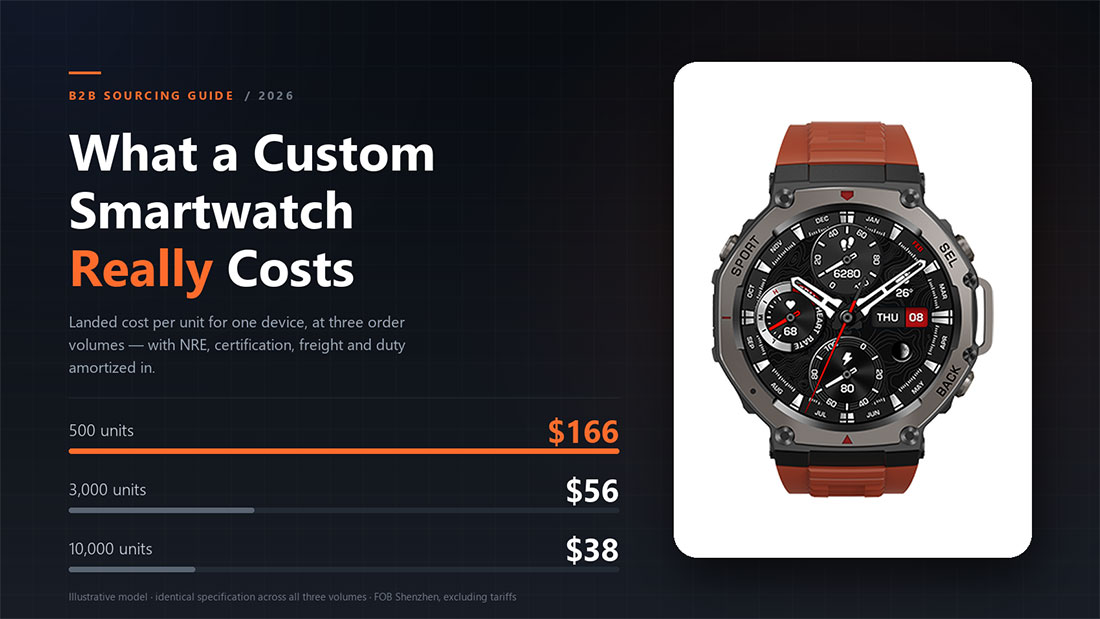
|
Per unit
|
500 units
|
1,000 units
|
3,000 units
|
10,000 units
|
|---|---|---|---|---|
|
Unit FOB
|
$42.00
|
$38.00
|
$33.00
|
$29.00
|
|
NRE, amortized
|
$90.00
|
$45.00
|
$15.00
|
$4.50
|
|
Certification, amortized
|
$30.00
|
$15.00
|
$5.00
|
$1.50
|
|
Freight and duty
|
$4.00
|
$3.50
|
$3.00
|
$2.80
|
|
Landed cost
|
$166.00
|
$101.50
|
$56.00
|
$37.80
|
The 500-unit column is the one that matters. Your watch costs $42 and your decision costs $124. NRE and certification together make up 72% of landed cost at that quantity. At 10,000 units the same two lines fall to $6, or 16%.
|
Cost
|
Typical scale
|
What it does to your model
|
|---|---|---|
|
Warranty reserve
|
1% – 3% of FOB
|
Units that fail in the field are replaced at your cost, not the factory's, unless the contract says otherwise.
|
|
Payment terms and financing
|
30% deposit, 70% against the bill of lading
|
You finance the entire production run for six to eight weeks before any revenue arrives.
|
|
Certification maintenance
|
$2,000 – $6,000 per model per market, per standard revision
|
Standards get updated. A compliant product does not stay compliant for free.
|
|
App and firmware maintenance
|
$5,000 – $20,000 a year
|
iOS and Android force updates. An app that is not maintained becomes a one-star listing.
|
|
Spare parts and RMA logistics
|
1% – 2% of FOB
|
Straps, chargers, displays, plus the shipping to receive, test and re-ship returns.
|
|
Component EOL re-testing
|
$10,000 – $25,000 per event
|
A chip goes end-of-life, the board changes, and the radio report must be redone.
|
|
Freight volatility and tariffs
|
Model at 8% – 15% of FOB
|
Rates and duty treatment move faster than your price list. Model a band, not a number.
|
|
Localization
|
$300 – $1,500 per language
|
Manual, box copy, app strings and legal notices all need proper translation, not machine output.
|
The sourcing model is the first budget decision. Private label smartwatch cost sits at the low end of the table below, full custom at the high end, and no discount moves a program across tiers.
|
Dimension
|
White label
|
ODM semi-custom
|
Full custom
|
|---|---|---|---|
|
NRE
|
$0 – $3,000
|
$15,000 – $45,000
|
$60,000 – $150,000+
|
|
Unit FOB
|
$12 – $28
|
$18 – $45
|
$35 – $120+
|
|
MOQ
|
100 – 500
|
500 – 1,000
|
2,000 – 5,000
|
|
Lead time, first order
|
3 – 6 weeks
|
8 – 14 weeks
|
14 – 20 weeks, plus certification
|
|
Differentiation
|
Logo, packaging, dial, maybe strap
|
Housing, UI, packaging, app skin
|
Everything, including the board and sensor stack
|
|
Best for
|
Pilot launches, corporate gifts, channel tests
|
Brands with a design language and a shelf to fill
|
Hardware-led brands with a software ecosystem
|
Five signals that a quotation will cost you more later than it does now:
|
Signal
|
Why it is a problem
|
|---|---|
|
A single total, no BOM breakdown
|
You cannot compare it with anything, and every future change is priced by the same person who refused to itemize.
|
|
Tooling quoted far below market
|
Either the mould is shared with other clients, or the cost reappears inside the unit price, or the tooling is not yours to take.
|
|
"Certification included", no scope
|
Usually means basic CE only. Radio, SAR and battery transport tests are separate line items.
|
|
MOQ you can have at any size
|
At 200 units the NRE has to go somewhere. It goes into the unit price, and it stays there at 2,000.
|
|
Lead time with no start date
|
Counted from order or from artwork approval, the same promise differs by three weeks.
|
|
Line
|
Amount
|
|---|---|
|
NRE: housing, UI, packaging
|
$25,000
|
|
Certification, EU and North America
|
$12,000
|
|
Goods, 500 units at $42 FOB
|
$21,000
|
|
Freight, insurance, duty
|
$2,000
|
|
Total program
|
$60,000, about $120 per unit landed
|
Choose this when the product concept is still unproven and 500 units is enough to sell through one channel and read the returns rate. Accept that most of the money is buying information rather than inventory.
|
Line
|
Amount
|
|---|---|
|
NRE: new ID, tooling, firmware, packaging
|
$45,000
|
|
Certification, EU and North America
|
$15,000
|
|
Goods, 3,000 units at $33 FOB
|
$99,000
|
|
Freight, insurance, duty
|
$9,000
|
|
Total program
|
$168,000, about $56 per unit landed
|
Choose this when you have a repeatable sales channel and a design identity worth protecting. This is the volume band where amortization stops being the dominant term and your specification starts driving the number.
|
Line
|
Amount
|
|---|---|
|
NRE: ID, tooling, PCB, firmware, app, packaging
|
$120,000
|
|
Certification, multiple markets
|
$25,000
|
|
Goods, 10,000 units at $29 FOB
|
$290,000
|
|
Freight, insurance, duty
|
$28,000
|
|
Total program
|
$463,000, about $46 per unit landed
|
Money leaves before product does. The usual structure is 30% deposit, 40% before mass production, 30% against the bill of lading.
|
Stage
|
Payment
|
What you should have in hand
|
|---|---|---|
|
Kickoff and NRE
|
30% deposit plus NRE
|
Signed spec, tooling ownership clause, artwork schedule
|
|
EVT samples
|
—
|
Working units, first functional test report
|
|
DVT samples
|
—
|
Reliability results, certification pre-scan
|
|
Pre-production
|
40%
|
Golden sample signed off, packaging proof approved
|
|
Shipment
|
30%
|
Bill of lading, inspection report, test certificates
|
A full-custom program runs fourteen to twenty weeks from tooling release to mass production, with certification running in parallel for four to eight of those weeks. EVT usually lands four to six weeks after first tooling samples, DVT another four to six, pre-production three to four, and mass production two to three.
WhatsApp: +86 186 8227 4360. Or start with the specification form on our site and we will respond with an itemized quotation and a realistic schedule.
This section is for the web team. Delete it before the article goes live.
|
Field
|
Value
|
|---|---|
|
Title tag
|
Custom Smartwatch Cost: A Realistic B2B Budget Breakdown (56 characters)
|
|
Meta description
|
A line-by-line breakdown of custom smartwatch manufacturing costs: NRE, tooling, BOM, certification and landed cost at 500, 3,000 and 10,000 units. (152 characters)
|
|
URL slug
|
/custom-smartwatch-manufacturing-cost/
|
|
Primary keyword
|
custom smartwatch manufacturing cost. Exact-match target: 5–7 uses in a 3,000–3,800 word body, which is roughly 0.6–0.8% word density for a five-word phrase. It must appear in the title, the first 100 words, at least one H1, and the conclusion.
|
|
Secondary keywords
|
Tier 2, commercial-intent variants: smartwatch manufacturing cost, private label smartwatch cost, smartwatch OEM cost, custom smartwatch price. Tier 3, long-tail sub-questions: smartwatch tooling cost, smartwatch MOQ, minimum order quantity, cost to manufacture a custom smartwatch. Each appears two to four times, always inside the section that actually answers it.
|
|
Schema
|
Article, FAQPage, BreadcrumbList. Do not mark up Product or Offer: the figures are ranges and would be flagged as inaccurate pricing.
|
|
Internal links
|
Smartwatch OEM vs ODM (link from "White Label, ODM, or Full Custom"); Smartwatch MOQ Explained (from the NRE section); CE RED Certification for Smartwatches (from the certification rows); How to Choose a Smartwatch Manufacturer in China (from "How to Read a Smartwatch Quotation")
|
|
External links
|
EU Radio Equipment Directive pages, FCC equipment authorization pages, UN38.3 transport testing guidance. Two or three links, official sources only.
|
The body runs about 3,500 words. Density is measured against the whole article, tables included, so 0.6% already means a keyword is carrying weight without crowding the prose.
|
Keyword
|
Role
|
Target uses
|
Where it lands
|
|---|---|---|---|
|
custom smartwatch manufacturing cost
|
Primary
|
5 – 7
|
Title, first 100 words, two H1s, FAQ, conclusion
|
|
custom smartwatch price / custom smartwatch cost
|
Primary variants
|
3 – 4 each
|
Cost stack, unit cost tier, price drivers, FAQ
|
|
smartwatch manufacturing cost
|
Secondary, tier 2
|
2 – 3
|
Cost stack, how to read a quotation
|
|
private label smartwatch cost
|
Secondary, tier 2
|
2 – 3
|
Sourcing model section, cheapest-route FAQ
|
|
smartwatch OEM cost
|
Secondary, tier 2
|
2 – 3
|
White label vs ODM, quotation reading
|
|
smartwatch tooling cost
|
Secondary, tier 3
|
3 – 4
|
NRE section, tooling FAQ
|
|
smartwatch MOQ / minimum order quantity
|
Secondary, tier 3
|
2 – 4
|
Product tier table, MOQ FAQ
|
Three rules kept the density honest. No keyword appears twice in the same paragraph. Every keyword sits in the section that actually answers the question it implies, so a reader searching tooling cost lands on the tooling maths rather than a generic intro. Headings carry a keyword only where the phrase is the natural name of the section, which is why three H1s do it and the rest do not.